The Indian film industry is the oldest and the largest in the world with over 1200 movies released annually. The majority of films are made in the South Indian languages mostly Telugu, Tamil and Malayalam, but Hindi films take the largest box office share. Mumbai (Bombay), Chennai (Madras), Kolkata (Calcutta), Bangalore and Hyderabad are the main film production centers. With more than12000 cinema halls, the Indian film industry turn out more than 1000 films a year to hugely appreciative audiences around the world.
The first exposure to motion pictures that India received was when the Lumiere Brothers' Cinematographe unveiled six soundless short films, on July 7, 1896, at the Watson Hotel in Mumbai.
The first exposing of celluloid in a camera by an Indian and its consequent screening took place in 1899, when Save Dada shot two short films and exhibited them under Edison's projecting kinetoscope. As the early 1900s rolled in, with the country poised for major social and political reforms, a new entertainment form dawned in India -- the cinema.
Dadasaheb Phalke -- a man of versatile talent, who had a varied career as a painter, photographer, playwright and magician before he took to film -- was responsible for the production of India's first fully indigenous silent feature film, Raja Harishchandra, adapted from the Mahabharata.
The film had titles in Hindi and English, and was released on May 3, 1913 at the Coronation Cinema in Mumbai. This laid the foundation of what, in time, would grow to become the largest film producing industry in the world. After stepping into 1920, Indian cinema gradually assumed the shape of a regular industry, producing silent films and also coming within the purview of the law. The new decade saw the arrival of many new companies and filmmakers. Directors such as Dhiren Ganguly, Baburao Painter, Suchet Singh, Chandulal Shah, Ardershir Irani and V Shantaram were among the early pioneers. The increased profitability of the cinema enabled filmmakers to reinvest their gains in new productions and additional infrastructure such as studios, laboratories and theatres. By 1925, Mumbai had already become India's cinema capital. The most remarkable thing about the birth of the sound film in India is it came with a bang and quickly displaced silent movies.
The first Indian talkie, Alam Ara (1931) was a 124-minute feature produced by the Imperial Film Company in Mumbai and directed by Ardershir Irani
. Advertised as an all talking, all singing, all dancing film, it brought revolutionary changes in the whole set up of the industry The 1930s are recognised as a decade of social protest in the history of Indian cinema. Three big banner production companies -- Prabhat, Bombay Talkies and New Theatres -- took the lead in making gripping but entertaining films for all classes. A number of films that made a strong plea against social injustice were produced in this period, specifically some by V Shantaram. V Shantaram's illustrious career spanned seven decades from the 1920s to 1986. He was arguably the most innovative and ambitious filmmaker in the industry's history, creating 105 films as a director, producer and actor. His first talkie and bilingual film in 1932, Ayodhye Cha Raja, was about a legendary Indian king loved by all his subjects and remembered for his fairness Mehboob Khan's Mother India (1957), for instance, focused on political themes and social critique within a pop culture setting. The 1960s began with a bang with the release of K Asif's Mughal-E-Azam, which set a box-office record. An epic about Prince Salim, son of the Emperor Akbar, and his forbidden romance with court dancer Anarkali, it was one of the most expensive films to produce at the time and took 10 years to make.

Creativity

"The problem of creativity is beset with mysticism, confused definitions, value judgments, psychoanalytic admonitions, and the crushing weight of philosophical speculation dating from ancient times." Albert Rothenberg

Creativity (or creativeness) is a mental process involving the generation of new ideas or concepts, or new associations between existing ideas or concepts.

From a scientific point of view, the products of creative thought (sometimes referred to as divergent thought) are usually considered to have both originality and appropriateness. An alternative, more everyday conception of creativity is that it is simply the act of making something new.

Although intuitively a simple phenomenon, it is in fact quite complex. It has been studied from the perspectives of behavioural psychology, social psychology, psychometrics, cognitive science, artificial intelligence, philosophy, history, economics, design research, business, and management, among others. The studies have covered everyday creativity, exceptional creativity and even artificial creativity. Unlike many phenomena in science, there is no single, authoritative perspective or definition of creativity. Unlike many phenomena in psychology, there is no standardized measurement technique.

Creativity has been attributed variously to divine intervention, cognitive processes, the social environment, personality traits, and chance ("accident," "serendipity"). It has been associated with genius, mental illness and humour. Some say it is a trait we are born with; others say it can be taught with the application of simple techniques.

Although popularly associated with art and literature, it is also an essential part of innovation and invention and is important in professions such as business, economics, architecture, industrial design, science and engineering.

Despite, or perhaps because of, the ambiguity and multi-dimensional nature of creativity, entire industries have been spawned from the pursuit of creative ideas and the development of creativity techniques. This mysterious phenomenon, though undeniably important and constantly visible, seems to lie tantalizingly beyond the grasp of scientific investigation.

"Creativity, it has been said, consists largely of re-arranging what we know in order to find out what we do not know." George Kneller

Vizthinking

Vizthinking is our way of identifying a very useful skill that is yours to use if we can help you

break through your conditioned inhibitions about thinking and communicating. It is a way of

making your perceptual thinking tangible in a visual form to be used for creating concepts and

generating ideas. It is a way of thinking with your senses and Deceptions.

Idea visualization (or vizthinking) is vital for the copywriter, journalist, publicist, advertising

designer, display designer, graphic artist, or just plain doodler.

In the business of advertising, the job of providing the layout, visual, and graphics for an

advertisement is that of the art director. The copywriter has, as her daily task, the job of creating

the words of the advertisement and, at the height of her activity, of creating the basic concept.

It is in line with this conceptual part of her work that a copywriter needs to be able to think

visually. Our term for thinking visually is vizthinking. More important, we have developed a

series of "vizthinks," which we hope will be a virtual "layout and graphics course for

copywriters."

The copywriter should be able to convey her thinking and preferences for the visualization of

copy and concepts to an art director. She must do this clearly, taking full advantage of the

various ways in which a product can be visualized in print, film, video tape, or in the "mind's

eye" of radio.

This calls for a large degree of cooperation between the copywriter and the art director. If the

proper rapport exists, the road is smooth. A great deal of tact and deft handling is called for on

the copywriter's part. She must not seem to be assuming the role of art director. She must,

nevertheless, get her idea across to the art department. A successful copywriter will be effective

at this, as well.

Many copywriters do think visually. This does not mean that they can draw. We have

demonstrated in our idea visualization classes that vizthinks are a way that copywriters can learn

to "draw" thumbnails, rough layouts, and visuals that really help their writing. The ability to

visualize may help the art director clearly see the central idea of the ad as conceived by the copywriter.

Vizthinking is not a drawing technique as much as it is a way of thinking with your senses. It is a

tool that uses the medium of drawing, sketching, doodling, or thumbnailing to record perceptions

of the mind's eye. It means that you are able to think in pictures that demonstrate some benefit,

satisfaction, use', or feature of the product.

Depending upon the rapport that may exist with an art director, a copywriter who develops a skill

for drawing rough layouts and visuals may also find it wise to add an extra dimension: a

description of the idea in words. However, this is usually unnecessary, when a rough layout is a

clear explanation of what is wanted.

The importance of idea visualization in the selling process should be stressed here. Earlier, in the

discussion of headlines, the point was made that the visual shares with the headline the task of

taking the early steps of the selling process, that of capturing the attention and arousing the

interest of the potential consumer. It is natural, then, that the copywriter who will write the

headline may also think about the visualization simultaneously.

Visualizing your product can obviously be handled effectively in many different ways. Your

choice will be influenced by the product itself, current happenings, and perhaps by the policies

set up by your predecessors.

In visualization, as in copywriting, identification and involvement are again the important

concepts to keep in mind. Certainly, the visualization will depend to a great extent on who will

be looking at your advertisement. Surveys indicate that, contrary to general opinion, men tend to

look at pictures of men in ads, women at pictures of women. Naturally, this rule does not apply

to the deliberately provocative, bare "midriff-plus" visualization that is intended to make

everyone look at "everything." The identification of women with women, and so forth, does

apply to the day-in. day-out advertising that makes up the bulk of the promotions.

The choice of visualization should, above all, be determined the central selling message and copy

appeal that you, as copywriter. Have developed for the advertisement or advertising campaign.

By indicating your preference and your own ideas to the art director. You can be more certain

that the essential concept of your advertisements and campaign will be carried out.

RESEARCH: A SOURCE OF CONCEPTS

There never has been a better stimulus to creative thinking than solid research. Marketing

research that has accurately defined a marketing problem, focused on a target group in a specific

market carefully defined the audience, and thus helped to select copy appeals and approaches can

be the best foundation for the creative connection. The efforts spent on research can actually cut

the time needed for verbal visual problem-solving. Solid research may serve to suggest

alternative solutions to marketing problems, indicating additional verbal and visual approaches to

a given problem.

The successful creative connection is like good orchestration in music. It works well because

various instrumental elements have harmonized to produce a sound that says more than any

individual instrument by itself.

TRY WORD/PICTURE ASSOCIATIONS

The creative connection is an optimum blend of visual and verbal elements which uniquely

reinforce each other. The copywriter / visualizer or visualizer/copywriter must make creative

decisions that choose the most effective pictures and words to deliver a message. A concept such

as trust can be described by words. How would you describe it in a picture? On the other hand,

which would better describe a chunk of tender lobster claw dipped in drawn butter, words or a

color photograph? There are no simple answers to such questions. But, certainly, a compelling

picture strongly supported by carefully composed words can evoke a great response than the

proverbial thousand words or a thousand pictures working alone.

To practice word/picture associations that can communicate your ideas quickly, clearly, and

simply, try listing at least three pictures in words that illustrate the word "trust."

Now assume that your advertisement is for a manufacturer of pharmaceuticals sold "across the

counter," i.e., without a prescription. What kind of a headline would you write for an antacid

tablet which would work with your visual to reinforce the concept of "trust?"

Keep in mind that the creative connection depends upon you ability to compare ideas. The idea

visualization process will attempt to-mesh Ideas you know about your audience-emotions,

values, attitudes, desires, and needs-with what you know about your product. This process is

aided by assembling many times more material than would be used in the ad. To compile this

information, read everything produced by your client, talk to every "old timer" in the company,

study the product, talk to consumers. When you have more than enough, the possibilities are

enormous.

The creative connection attempts to connect "people" attributes with product characteristics'" and

then develop. a message in words and pictures which will appeal to the target audience. An

essential part of process is the consideration of the perceptual fames of reference of your target

audience. The objective of the _ message is to evoke response from as much of the audience as

possible. Perceptual psychology has given us a clue to patterns of thinking and how our mind

processes visual stimuli.

IDEAS COME FROM THE LEFT AND RIGHT

Part of the excitement of working in the field .of advertising is the constant updating of

psychological concepts that can be put to work in our field. The analysis of consumer motivation

and behavior struggles to keep up with new scientific data and with the resulting information

about the way people act and react. From these new speculations, the question has arisen about

the effect of the growing awareness concerning the differences between the right and the left

hemispheres of the brain. What effect will this have on the planning of advertising both for copy

and visuals? While the differences have been known for some time, it is only lately that the

subject has been treated by skilled writers for presentation outside of the scientific world.

Subsequently, some advertising research people have taken up the study in an effort to apply

what is known to the creation of more effective advertising.

Carl Sagan of Cornell University is considered by many to be a leader among those scientists

who can write on important scientific subjects in such a way that the rest of us can understand.

Some of the information that follows is based on his writings.

The left hemisphere of the brain provides reasoning and verbal skills; it processes information

sequentially (step by step). The right hemisphere provides us with intuition and intuitive

responses; it processes information simultaneously (all at once). For example, when we dream,

the right hemisphere takes over, while the left is suppressed. The left hemisphere recognizes

words; the right, signs and symbols. The left responds to a logical verbal presentation, while the

right responds to color and to total patterns. However, Sagan cautions: "It is vital not to

overestimate the separation of functions on either side. .

Cinema

Cinema is the popular art form that has proved itself to be a good entertainer and a strong means of mass communication in Kerala since the last century. It has the elements of different art forms including architecture and sculpture in it.
Indian Art Cinema
India is well known for its commercial cinema, better known as Bollywood. In addition to commercial cinema, there is also Indian art cinema, known to film critics as "New Indian Cinema" or sometimes "the Indian New Wave" (see the Encyclopedia of Indian Cinema). Many people in India plainly call such films as "art films" as opposed to mainstream commercial cinema. From the 1960s through the 1980s, the art film or the parallel cinema was usually government-aided cinema. Such directors could get federal or state government grants to produce non-commercial films on Indian themes. Their films were showcased at state film festivals and on the government-run TV. These films also had limited runs in art house theatres in India and overseas. The directors of the art cinema owed much more to foreign influences, such as Italian Neo-Realism or French New Wave, than they did to the genre conventions of commercial Indian cinema. The best known New Cinema directors were Bimal Roy, Ritwik Ghatak, and Satyajit Ray. The best known films of this genre are the Apu Trilogy (Bengali) by Satyajit Ray and Do Bigha Zameen (Hindi) by Bimal Roy. Satyajit Ray was the most flourishing of the "art cinema" directors. His films played primarily to art-house audiences in the larger Indian cities, or to film buffs on the international circuit. In South India, art cinema or the parallel cinema was well-supported in the state of Kerala. Malayalam movie makers like Adoor Gopalakrishnan, G. Aravindan, and M. T. Vasudevan Nair were quite successful. Starting the 1970s, Kannada film-makers from Karnataka state produced a string of serious, low-budget films. But virtually only one director from that period continues to make off-beat films -- Girish Kasaravalli. In other markets of south India, like Kannada, Tamil, Malayalam, and Telugu, stars and popular cinema rule the box office. Still, a few directors, such as Balachander, Bharathiraja, Balu Mahendra, Bapu, Puttanna, Siddalingaiah, Dr.K.Vishwanath, and Mani Ratnam have achieved fair amount of success at the box-office while balancing elements of art and popular cinema together.
Indian Commercial Cinema
Commercial cinema is the most popular form of cinema in India. Ever since its inception the commercial Indian movies have seen huge following. Commercial or popular cinema is made not only in Hindi but also in many other regional languages of East and South India. Let's look at some of the general conventions of commercial films in India. Commercial films, in whatever languages they are made, tend to be quite long (approx three hours), with an interval. Another important feature of commercial cinema in India is music. The action in commercial movies is periodically interrupted by song-and-dance sequences. Good movies use the routines to move the story forward; mediocre movies incorporate them to woo the audience. Songs are sung by professional play-back singers and lip-synched by dancing actors and actresses. The popular cinema in India is a mix of melodrama and sentiments. These movies have a mix of romance, comedy, action and suspense.

Mise en scène

Mise en scène is everything that appears before the camera, Namely: the setting the costume and make-up the use of figure, expression and movement by actors the lighting The style scale Formalism, expressionism ↔ Realism Form over content - how things are shown is most important, and beyond a usual representation of reality. Expressionist films are highly stylised, and are characterised by oblique camera angles, distorted shapes, bizarre settings, high contrast lighting and the surreal and subjective. ↔ Content over form - looks like real life - the intent is to make us forget it is a representation. This is the dominant style of most films, and is sometimes referred to as "the style of no style." Setting Setting gives a sense of place and time. Whatever the film is, you should always analyse the set because it provides important clues about the nature of the film, such as: where the action takes place when the action takes place the mood the characters the genre of the film. Costume and make-up Costume and make-up can be considered as part of the set, because they indicate: the period the state of society social class cultural backgrounds character traits. Changes in cosutume indicate changes in charecter, e.g.: rich to poor taking off clothes as lowering defenses. Clothing might also be a trademark. Figure, expression and movement Body language appearance facial expressions (very significant in close-ups) sound elements. The way a character stands and moves is important. If they are the foreground they might be considered more important. If they move against a stationary background attention is drawn to them. Even distribution of characters makes for a balanced shot, whereas uneven distribution is unsettling to the eye. Positioning of characters within the frame may even indicate emotional distance.

Divergent thinking & Convergent thinking

  • Divergent thinking is the process of creating a list of items based on a single input. In this case, you begin with a task and consider all the ways that you can accomplish that task without thinking in specifics.
  • Convergent thinking is the process of converting all of the general ideas—the goals and non-specific solutions—into the specific solutions that form an application.

Creativity

Creativity, it has been said, consists largely of re-arranging what we know in order to find out what we do not know." George Kneller
Creativity (or creativeness) is a mental process involving the generation of new ideas or concepts, or new associations between existing ideas or concepts.
From a scientific point of view, the products of creative thought (sometimes referred to as divergent thought) are usually considered to have both originality and appropriateness. An alternative, more everyday conception of creativity is that it is simply the act of making something new. Although intuitively a simple phenomenon, it is in fact quite complex. It has been studied from the perspectives of behavioural psychology, social psychology, psychometrics, cognitive science, artificial intelligence, philosophy, history, economics, design research, business, and management, among others. The studies have covered everyday creativity, exceptional creativity and even artificial creativity. Unlike many phenomena in science, there is no single, authoritative perspective or definition of creativity. Unlike many phenomena in psychology, there is no standardized measurement technique. Creativity has been attributed variously to divine intervention, cognitive processes, the social environment, personality traits, and chance ("accident," "serendipity"). It has been associated with genius, mental illness and humour. Some say it is a trait we are born with; others say it can be taught with the application of simple techniques.

Although popularly associated with art and literature, it is also an essential part of innovation and invention and is important in professions such as business, economics, architecture, industrial design, science and engineering. Despite, or perhaps because of, the ambiguity and multi-dimensional nature of creativity, entire industries have been spawned from the pursuit of creative ideas and the development of creativity techniques. This mysterious phenomenon, though undeniably important and constantly visible, seems to lie tantalizingly beyond the grasp of scientific investigation.

LATERAL THINKING

LATERAL THINKING

The term 'lateral thinking' in 1967. It was first written up in a book called "The Use of Lateral Thinking" (Jonathan Cape, London) - "New Think" (Basic Books, New York) - the two titles refer to the same book.

For many years now this has been acknowledged in the Oxford English Dictionary which is the final arbiter of the English Language.

There are several ways of defining lateral thinking, ranging from the technical to the illustrative.

1. "You cannot dig a hole in a different place by digging the same hole deeper"

This means that trying harder in the same direction may not be as useful as changing direction. Effort in the same direction (approach) will not necessarily succeed.

2. "Lateral Thinking is for changing concepts and perceptions"

With logic you start out with certain ingredients just as in playing chess you start out with given pieces. But what are those pieces? In most real life situations the pieces are not given, we just assume they are there. We assume certain perceptions, certain concepts and certain boundaries. Lateral thinking is concerned not with playing with the existing pieces but with seeking to change those very pieces. Lateral thinking is concerned with the perception part of thinking. This is where we organise the external world into the pieces we can then 'process'.

3. "The brain as a self-organising information system forms asymmetric patterns. In such systems there is a mathematical need for moving across patterns. The tools and processes of lateral thinking are designed to achieve such 'lateral' movement. The tools are based on an understanding of self-organising information systems."

This is a technical definition which depends on an understanding of self-organising information systems.

4. "In any self-organising system there is a need to escape from a local optimum in order to move towards a more global optimum. The techniques of lateral thinking, such as provocation, are designed to help that change."

This is another technical definition. It is important because it also defines the mathematical need for creativity.

Resume Writing Tips

Resume Writing Tips

  • List your technical knowledge first, in an organized way. Your technical strengths must stand out clearly at the beginning of your resume. Ultimately, your resume is going to be read by a thoughtful human being, but before it gets to that point it often has to be categorized by an administrative clerk, and make its way past various sorts of key word searches. Therefore, you should list as many directly relevant buzz words as you can which reflect your knowledge and experience. List all operating systems and UNIX flavors you know. List all programming languages and platforms with which you're experienced. List all software you are skilled with. Make it obvious at a glance where your strengths lie - whether the glance is from a hiring manager, a clerk, or a machine.
  • List your qualifications in order of relevance, from most to least. Only list your degree and educational qualifications first if they are truly relevant to the job for which you are applying. If you've already done what you want to do in a new job, by all means, list it first, even if it wasn't your most recent job. Abandon any strict adherence to a chronological ordering of your experience.
  • Quantify your experience wherever possible. Cite numerical figures, such as monetary budgets/funds saved, time periods/efficiency improved, lines of code written/debugged, numbers of machines administered/fixed, etc. which demonstrate progress or accomplishments due directly to your work.
  • Begin sentences with action verbs. Portray yourself as someone who is active, uses their brain, and gets things done. Stick with the past tense, even for descriptions of currently held positions, to avoid confusion.
  • Don't sell yourself short. This is by far the biggest mistake of all resumes, technical and otherwise. Your experiences are worthy for review by hiring managers. Treat your resume as an advertisement for you. Be sure to thoroughly "sell" yourself by highlighting all of your strengths. If you've got a valuable asset which doesn't seem to fit into any existing components of your resume, list it anyway as its own resume segment.
  • Be concise. As a rule of thumb, resumes reflecting five years or less experience should fit on one page. More extensive experience can justify usage of a second page. Consider three pages (about 15 years or more experience) an absolute limit. Avoid lengthy descriptions of whole projects of which you were only a part. Consolidate action verbs where one task or responsibility encompasses other tasks and duties. Minimize usage of articles (the, an, a) and never use "I" or other pronouns to identify yourself.
  • Omit needless items. Leave all these things off your resume: social security number, marital status, health, citizenship, age, scholarships, irrelevant awards, irrelevant associations and memberships, irrelevant publications, irrelevant recreational activities, a second mailing address ("permanent address" is confusing and never used), references, reference of references ("available upon request"), travel history, previous pay rates, previous supervisor names, and components of your name which you really never use (i.e. middle names).
  • Have a trusted friend review your resume. Be sure to pick someone who is attentive to details, can effectively critique your writing, and will give an honest and objective opinion. Seriously consider their advice. Get a third and fourth opinion if you can.
  • Proofread, proofread, proofread. Be sure to catch all spelling errors, grammatical weaknesses, unusual punctuation, and inconsistent capitalizations. Proofread it numerous times over at least two days to allow a fresh eye to catch any hidden mistakes.
  • Laser print it on plain, white paper. Handwriting, typing, dot matrix printing, and even ink jet printing look pretty cheesy. Stick with laser prints. Don't waste your money on special bond paper, matching envelopes, or any color deviances away from plain white. Your resume will be photocopied, faxed, and scanned numerous times, defeating any special paper efforts, assuming your original resume doesn't first end up in the circular file.

The Ultimate Screen Play

Run Lola Run(1999) Tom Tykwer (Writer/Director)
The Story
When we meet Manni (Moritz Bleibtreu), a small time courier for big time gangster, he is working a standard pick-up/drop-off, and everything is going just fine. When the job is done, all he has to do is wait for his girlfriend, the orange-haired punk girl Lola (Franka Potente), to pick him up. But today is unlike any other day. Due to an incident while she was buying a pack of cigarettes, Lola is late, and Lola is never late. One stroke of bad luck leads to another, and by the time Manni calls Lola, he is at a pay phone with a big, big, big problem. His unforgiving boss will meet him in twenty minutes to pick up 100,000 marks; money that Manni, suddenly, does not have. Lola rushes out of her apartment and down the street, attempting to get to Manni and, somehow, pick up 100,000 marks on the way. She tears through the city, in a whirl of bums, nuns, babies and guns. Down sidewalks, into offices, through traffic and back again. As her feet slap the pavement and the seconds tick down, the tiniest choices become life altering (or ending) decisions, and the fine line between fate and fortune begins to blur.

A simple story told with much warmth and compassion.

some times some films may make some wonder inside the heart ... this is it ...
The way home
Dedicated to grandmothers everywhere',
"The Way Home (Jibeuro)" could easily be called the best Korean film of 2002. Detailing the travails of a spoiled 7-year old boy who is left in the care of his 77-year old grandmother in the countryside, "The Way Home" is writer/director Lee Jung-hyang's simple yet touching follow-up to "Art Museum by the Zoo (Misulgwan yup dongmulwon)". Made on a paltry budget of $1.2 million US, this quiet drama was a welcome antidote to the high-profile blockbuster flops that littered the Korean moviegoing landscape that year. The film begins with Sang-woo (Yu Seung-ho) being dropped off at the rural hovel of his deaf-and-mute grandmother (Kim Eul-bun) so that his mother (Dong Hyo-heui) can go job-hunting unfettered in Seoul. Unfortunately, Sang-woo does not adapt well to his new surroundings. His grandmother is unable to speak and has diminished mental faculties, making communication difficult. Furthermore, the country lifestyle, without the modern conveniences of television or running water, comes as a bit of shock to the video game-playing Sang-woo. Frustrated by his new home, Sang-woo begins to lash out, which includes calling his grandmother a 'retard'. But despite her grandson's bratty and disrespectful behavior, the grandmother displays the patience of a saint as she quietly goes about her business of cooking his meals, washing his clothes, and gathering his drinking water from the local well. Over time, her persistence eventually pays off, as a maturing Sang-woo slowly comes to appreciate the sacrifices that have been made to give him a home. With "The Way Home", director Lee skilfully mines the dramatic potential between her two main characters. Most of the film's emotional pull comes from Sang-woo being completely oblivious to the consequences of his selfish actions, as well as from his grandmother's tireless efforts to care for him. This dichotomy is most apparent in two of the film's most moving scenes. In the first, Sang-woo freaks out after his grandmother boils him chicken after having shown her a picture of Kentucky Fried Chicken-- unfortunately, the effort that went into such an act of maternal love, which includes a trek into town through pouring rain, is completely lost on Sang-woo. The second is a bus trip into town where the grandmother is almost reduced to begging to sell her vegetables on the street in order to buy Sang-woo a new pair of shoes-- but as usual, Sang-woo ends up snubbing his grandmother on the bus ride home to hang out with a girl he likes (Yim Eun-kyung). Aside from the most literal interpretation, "The Way Home" could also be considered an examination of the gap between South Korea's older generation, which has witnessed the painful emergence of the country's democracy, and its youth, who have grown up in a world of cell phones, Internet access, and music videos. Like Sang-woo, it is sometimes easy to forget that today's "Take Care of My Cat" generation owes much of their liberties and luxuries to the sacrifices made by their "Peppermint Candy" predecessors. In addition to the well-paced and well-told story, the performances that Lee brings out of her two leads are both stirring and credible. Kim, who plays the grandmother, is not a professional actress, and she was actually brought on board after being spotted in a small country village. Without the benefit of dialogs, Kim's weathered face and simple expressions give her character an air of quiet dignity, stoic determination, and unwavering love. Yu, who is one the film's only professional actor, is also excellent as the bratty Sang-woo, who eventually comes to appreciate and care for his grandmother. Together, these two actors form an uncommon cinematic pairing that hooks the audience in, and make reaching for the Kleenex in the third act inevitable. After being released in its native South Korea, "The Way Home" quickly made its way into the hearts of the nation's moviegoers, and by year's end, it had become the second-highest grossing homegrown production for 2002 (behind "Marrying the Mafia"). "The Way Home" has also found its way onto movie screens around the world, including becoming the second-most successful North American release of a Korean film (behind "Chunhyang"),
After watching "The Way Home", it is not difficult to see why the film has had such a profound impact-- after all, I am sure that at one time or another, we have all been as impatient and self-absorbed as Sang-woo, and it was only through the patience and wisdom of our parents and grandparents that have made us for the better.

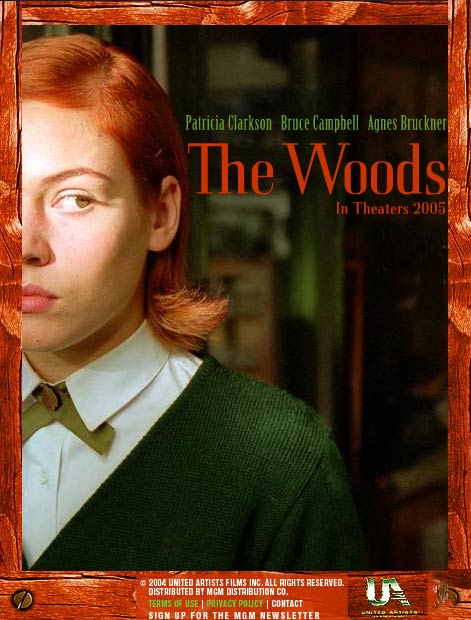
The Woods

A teenage girl is drawn into the path of the unknown in this tale of terror. Heather (Agnes Bruckner) is a teenage girl whose father (Bruce Campbell) and mother take little interest in her. Heather's parents enroll her in a private boarding school for girls located deep in a remote forest; Heather isn't happy with this turn of events, and she doesn't get along well with her classmates or the head mistress, Ms. Traverse (Patricia Clarkson). As she struggles to make the best of her situation, Heather notices that slowly but surely the other students at the school have been vanishing, and there seems to be a mysterious force in the nearby woods which has been claiming the lives of the young women -- and will soon be coming after Heather.

Sharing and Growing

I ask all of those who are using this blog, to make it more useful to others. Saying this i just want them to share their experiences with the other users so that others get guidance and motivation. Lets learn though mutual sharing of information

Mind Game >>> Sudoku

From Selvaprakash sir

Recently i read one intresting post for Young Photographer .I would like to share that post to you people.I Hope it will be usefull
Advice for young photographers-by Michael Kamber
I am writing this from the Baghdad bureau of The New York Times where I am on assignment. I have received dozens of queries from photojournalists starting out in the business. I am writing this in response, partly so I can refer others to it in the future and not spend time on lengthy replies. Some beginners ask for advice on gear,others on how to get started finding assignments and selling their work.
photo by selvaprakash
I will describe my own path into photojournalism here and give some general advice that may be useful. This is not definitive in any way. It is simply my experience and opinion formulated from twenty years experience as a photojournalist. No doubt others can weigh in and improve this with their comments and ideas. I started as a photojournalist by going to art school. I thought I would be a fine art or landscape photographer, but I took a photojournalism course and was quickly hooked. When my money ran out after a year, I dropped out of school, but continued to work as a teaching assistant for photojournalism classes. I may have learned more in this way than I did as a student. I received no credit, but photography is a meritocracy. In over 20 years, I have never been asked for my degree; in the world of photojournalism, your portfolio is your degree. I also learned a great deal from spending days in the library, reading about photojournalism and looking up, and discovering, each new name that I chanced upon. In this way I found Robert Capa, Robert Frank, Larry Clark, Alex Webb and dozens of others. If you are going to be a photojournalist, you should have a good working knowledge of the history of photojournalism, and of the medium’s iconic images. You can show me nearly any often published photograph from the 20th century and I can tell you who took it and where. I’ve studied the pictures carefully and memorized details about them. This is extremely useful and will help you later as you shoot. As you study images, you should think about where the photographer is in relation to the subjects, study how he or she has managed the light and the angle of the camera. Is the photo effective because it is compressed with a telephoto, or opened up with a wide-angle lens? And how did they get access, how will you gain access to a similar situation? I believe that the written word, still photos and film are connected. Artists in the above disciplines are telling stories, whatever the medium. It is important for those in one area to study the work of documentarians and artists in the others. At the bottom of this page is a list of recommended writers, photographers and filmmakers—all personal favorites. To be a photojournalist, you should be informed. I’m was appalled at a group of photographers who showed up in Haiti a few years ago, but did not know who the Duvalier’s were, or know even the most rudimentary history of the country. These countries are not there for you to practice photo-tourism and have an extended holiday. These are people’s lives you are documenting. Be knowledgeable and show respect. At the very least, you should read the front page or lead web stories each day from either the Washington Post, LA Times or NY Times. The New Yorker has the best long-form journalism in the English language. I read it every week. A second language is probably the most important skill you can acquire—far more important that the latest camera gear or a diploma from a photo school. It takes time, but you should speak at least basic French or Spanish in addition to English. Arabic, or a language spoken in China, would be an excellent choice also, especially as I write this in 2007. I began my “career” by photographing street demonstrations in New York and taking the pictures around to newspapers and wire services. There was easy access to what was happening, which is important when you’re starting out. And even the pictures I was not able to sell helped me to build a portfolio. I also began, almost immediately, to work on long-term projects. I cannot overstate the importance of long-term projects. Rather than run around taking hundreds of pictures of dozens of subjects, it is much better to spend a few weeks or a month with a family, or a group of people and get to know them. Your pictures will reveal your commitment as subjects become comfortable with you. Choose your projects carefully. There are hundreds of important projects out there waiting to be discovered and photographed. Photo editors know the commitment behind this kind of in-depth work, and they respect it. A good photo-essay on one project will be remembered and will help to get you assignments. You are going to have to promote yourself and your work. If you’re afraid of rejection, find another line of work. You have to take your work around, or send it out to editors constantly. Most will turn you away. That’s the nature of the business. Get used to it and don’t take it personally. I was crushed in 1985 when Fred McDarrah, an editor at The Village Voice, spent 30 seconds flipping through a portfolio I had spent months creating, then dismissed me with a flip of his hand. It took me a long time to get my courage up again, but I eventually did “break in” to The Village Voice, then a major photo publication. So you must be persistent. And remember that editors are extremely busy. Expect them to take a few minutes to see your work, not more. They don’t need to see hundreds of photos on many subjects. Show them 20 or 25 photos they will remember and you’ll be much better off. Notes on technique: When I am photographing, I often approach my subjects and explain what I am doing, then ask permission to take their picture. In the ideal situation, I will spend hours or days with a subject; they become comfortable with my presence and I can capture what I want. Sometimes I will carry a small album with my pictures, which I will show to people. This helps them to understand who I am and what I’m working on—there is some give and take. People always want to feel that you are not there to exploit them. Be sensitive to this. In a news situation I never ask permission, nor do I do anything to alter the situation as it is happening. Likewise, if I am on the street and see a moment in time that would be destroyed by my asking permission, I shoot without asking. I feel that this is my art and I have the right to practice it. I do not pay my subjects—it is unethical and makes it impossible for those who come after you to work without paying also. Notes on equipment: There is no magic camera that will make you take great pictures. Use what works for you. Develop a system that is reliable and that you are comfortable with. Never, under any circumstances, go on a major assignment with brand new equipment that you have not used. I don’t care if it is the latest and greatest. Often there will be glitches and growing pains, you don’t want these when you’re under the gun.For two decades I used primarily Leica rangefinders. I’m now doing a lot of work with Canon digital EOS models, mostly a 5D and a 24-70 zoom lens. In Africa, where I’m based, I always have a Hasselblad for portraits and usually a Leica as well. I still believe in film but have to acknowledge that for a newspaper photographer, it is impractical at best. I’m a bit of a “techie,” I carry a lot of gear when doing long assignments and am always experimenting with some new piece that will give me an edge. I know photographers far better than me that walk around with one battered body and a single lens and do great work. I hate flash and avoid it at all cost. Other photographers who I admire shoot with flash all the time. There is no right way to do it. I would say that a low light lens, preferably a wide-angle f1.4, or at least an f2, is a good investment. I shoot at night frequently, and here in Baghdad I am out with soldiers on night raids inside homes—flash is out of the question. There are exceptions to what I wrote above: in a combat situation, I do not carry a lot of gear. Usually one camera and one lens. Under fire is not a time to be fumbling with gear. Shoot what you can with what you have. I will update this as I get new ideas and suggestions and post it on my website, Kamberphoto.com Some of my recommended materials: Photo books: Eugene Richards, Cocaine True, Luc Delahaye, WinterRiesse Robert Frank, The Americans Gilles Peress, Telex Iran Mary Ellen Mark, anything by her. William Klein, anything you can find. Movies: Harlan County, USA, a documentary movie by Barbara Koppel My American Girls, a documentary video about a Dominican family Anything by the Maysle brothers. Anything by D.A. Pennebaker. Journalism: Joseph Mitchell, Up in the Old Hotel, Joan Didion, anything she’s ever done. Michael Herr, Dispatches, Guy Trebay, In The Place to Be, William Finnegan, Cold New World, Anything by Charlie Leduff or Barry Bearak in the New York Times. George Orwell, anything he’s ever written; Down and Out in Paris and London, and Homage to Catalonia, are particularly good.

Networking

Networking is used in every aspect of life and the computer communication has become an essential infrastructure. From schools to government offices, from shipping to advertising, from planning to accounting, the networking of computers are everywhere. Internet is the most important phenomenon in the concept of networking Networking is used in every aspect of life and the computer communication has become an essential infrastructure. From schools to government offices, from shipping to advertising, from planning to accounting, the networking of computers are everywhere. Internet is the most important phenomenon in the conc Many distinguished technology exists in networking with individual standards and are not compatible with each other. So multiple technologies are interconnected to provide a combination of networks. To understand the complexity in the networking, it is important to know the basics like wires connecting the computers, wiring schemes, communication protocols and about the network congestions

LAN TECHNOLOGY

A Local Area Network connects two computers and a printer and allows either of the computers to access the printer. LAN allow multiple computers and devices attach directly to a single, shared network. Local Area Network technology has become the most popular form of computer networks. With LAN more number of computers can be connected than with any other type of network. LAN technology is inexpensive and widely available ept of networking Several LAN designs emerged from the research. The designs differed in techniques and approaches to sharing mechanisms. Because of invention of many LAN technologies each are classified in terms of topologies. Networks are broadly classified into different categories based on the logical structure called topologies. The major topologies used in a LAN networks are STAR, RING and BUS topologies.

The Mumbai International Film Festival

The Mumbai International Film Festival for Documentary, Short and Animation Films is a biennial competitive event in film and video format and is organised by the Films Division a department of Ministry of Information and Broadcasting, Govt. Of India, in close co- operation of State Govt. Of Maharashtra. Films Division is Asia's biggest documentary and short film producer, having to its credit innumerable films that have won laurels at home and abroad during the last fifty years.

In this festival, outstanding films in various categories are selected by International Jury for Golden and Silver Conches with hefty cash prizes aggregating to 2.7 million Indian rupees (approx. US$ 60,000). The festival aims to serve as a platform where the film makers of the world can meet, exchange ideas , explore the possibility of co-production and market their films. The next festival, is 8th after its inauguration in 1990.

Programme:

The programme includes documentaries, short and animation films comprising the following :

Competition : Fiction, Non-Fiction and Animation films in film and Video (National), Video (International) formats.

Information films.

Retrospectives of selected International and Indian Documentary film makers.

International Film Market. Any film (including video film) can be registered in MIFF's International Film Market, irrespective of the year of production. All the films featuring in competition and information sections can also be registered.

Venues :

Press and Delegates : Prestigious Auditoria of Mumbai. Public : Well equipped cinema houses in the city.

Downlods

Imagine Cup win $8,000

Want a chance to win an all-expense paid vacation to Seoul, Korea, and a shot at some great prizes? You could win $8,000 for winning an invitational, or even $25,000 for winning the software design invitational. You’ll get to help the world and win money? It doesn’t get any better than that. . The world’s premier student technology competition, the Imagine Cup is one way Microsoft is encouraging young people to apply their imagination, their passion and their creativity to technology innovations that can make a difference in the world – today. Now in its fifth year, the Imagine Cup has grown to be a truly global competition focused on finding solutions to real world issues.
Competitions on
Technology Solutions
Skills Challenges
Digital Arts
Register here .........................................................................................................................................................................

Macro-environment:

Macro-environment: the major uncontrollable, external forces
  • Economic,
  • Demographic
  • Technological
  • Natural
  • Social and Cultural
  • Legal and political
which influence a firm's decision making and have an impact upon its performance

Micro Environmental Factors

Micro Environmental Factors >>These are internal factors close to the company that have a direct impact on the organisations strategy. These factors include:

The company > (Internal Environment)

They are needed to design and implement the marketing plans
  • Top management
  • Marketing manager
  • Finance
  • Research and development (R&D)
  • Purchasing
  • Manufacturing
  • Accounting

External environment or factors:

Customers

Organisations survive on the basis of meeting the needs, wants and providing benefits for their customers. Failure to do so will result in a failed business strategy.

Employees

Employing the correct staff and keeping these staff motivated is an essential part of the strategic planning process of an organisation. Training and development plays an essential role particular in service sector marketing in-order to gain a competitive edge. This is clearly apparent in the airline industry.

Employees

Employing the correct staff and keeping these staff motivated is an essential part of the strategic planning process of an organisation. Training and development plays an essential role particular in service sector marketing in-order to gain a competitive edge. This is clearly apparent in the airline industry.

Suppliers

Increase in raw material prices will have a knock on affect on the marketing mix strategy of an organisation. Prices may be forced up as a result. Closer supplier relationships is one way of ensuring competitive and quality products for an organisation.

Shareholders

As organisation require greater inward investment for growth hey face increasing pressure to move from private ownership to public. However this movement unleashes the forces of shareholder pressure on the strategy of organisations. Satisfying shareholder needs may result in a change in tactics employed by an organisation. Many Internet companies who share prices rocketed in 1999 and early 2000 have seen the share price tumble as they face pressures from shareholders to turn in a profit. In a market which has very quickly become overcrowded many will fall.

Media

Positive or adverse media attention on an organisations product or service can in some cases make or break an organisations. In the UK the adverse publicity the Millennium Dome has received has had impact on projected sales figures. Wheedler who recently entered the DVD market has received many award from industry magazine resulting in an increased demand for this product and most importantly an increased awareness of the Wheedler brand.

Consumer programmes on TV like the BBC's Watchdog with a wider and more direct audience can also have a very powerful and positive impact, forcing organisations to change their tactics.

Competitors

The name of the game in marketing is differentiation. What benefit can the organisation offer which is better then their competitors. Can they sustain this differentiation over a period of time from their competitors?. Competitor analysis and monitoring is crucial if an organisation is to maintain its position within the market.